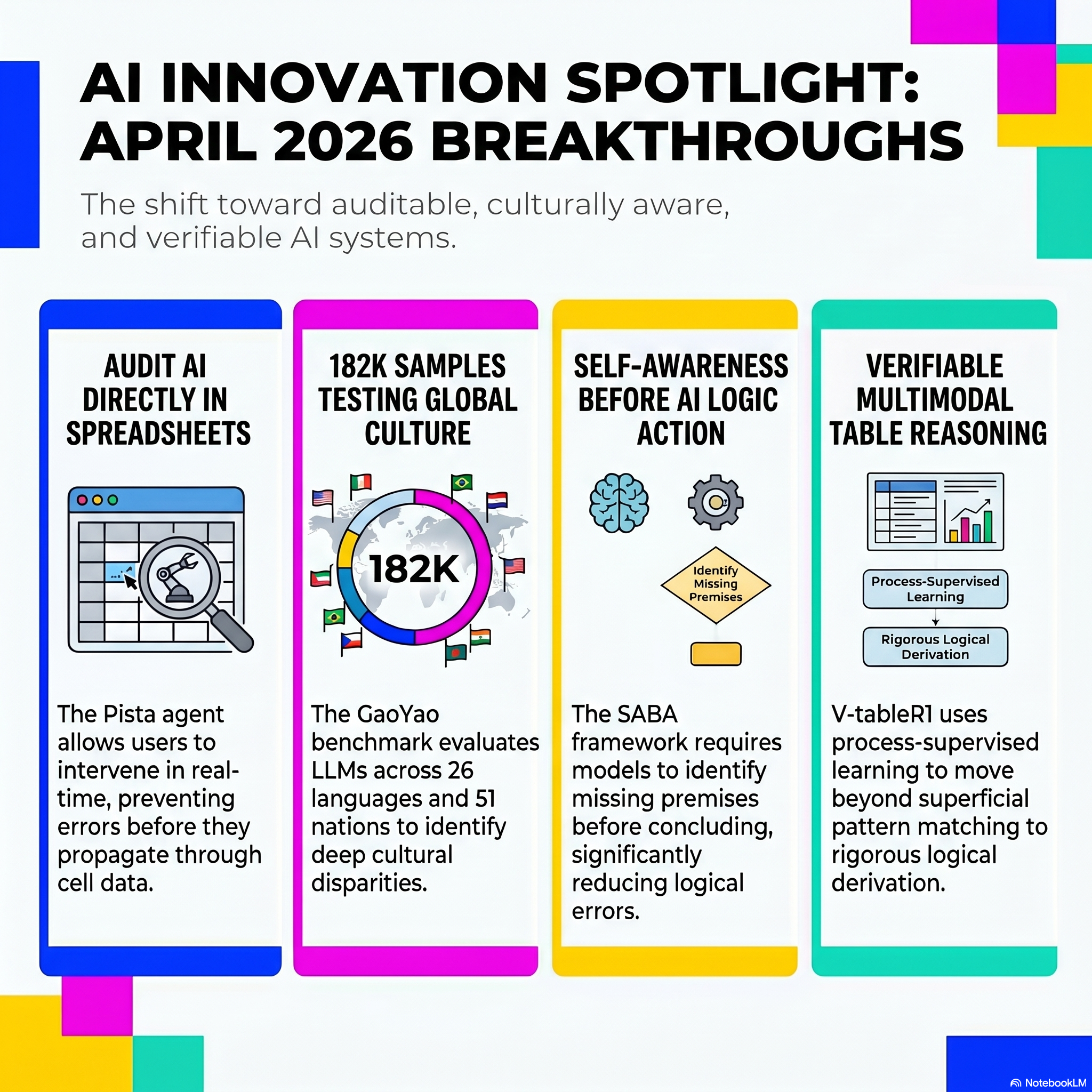
Because all the papers in this collection were submitted on the same day (April 22, 2026), there are no objective metrics like citation counts to measure their historical impact. However, based on the significance of the challenges they address, their novel methodologies, and their potential to shift paradigms in their respective fields, here are 10 highly impactful papers from the provided sources:
**1. Image Generators are Generalist Vision Learners**
This paper challenges the conventional boundaries between generative and perception models. It demonstrates that image generation pretraining acts as a generalist vision learner, similar to how LLMs develop reasoning capabilities. By introducing "Vision Banana," the authors show that reframing perception tasks as image generation yields state-of-the-art results on 2D and 3D vision tasks, suggesting a major paradigm shift toward unified Foundational Vision Models.
**2. Measuring the Machine: Evaluating Generative AI as Pluralist Sociotechical Systems**
This thesis critiques functionalist benchmarks in AI, arguing that they obscure how values are enacted and reify narrow cultural perspectives. It introduces the Machine-Society-Human (MaSH) Loops framework, treating generative AI evaluation as a recursive, pluralist sociotechnical process rather than a static test. This work is highly impactful for AI governance, arguing that benchmarks do not just measure reality but actively shape it.
**3. SWE-chat: Coding Agent Interactions From Real Users in the Wild**
Addressing the gap between curated benchmarks and real-world utility, this paper introduces the first large-scale dataset of real coding agent sessions from open-source developers. It uncovers crucial findings about how AI coding assistants are actually used: only 44% of agent-produced code survives into user commits, and agent-written code introduces more security vulnerabilities than human-authored code.
**4. Mythos and the Unverified Cage: Z3-Based Pre-Deployment Verification for Frontier-Model Sandbox Infrastructure**
In the wake of a critical frontier AI sandbox escape (the "Claude Mythos" incident), this paper introduces COBALT, a formal verification engine for detecting arithmetic vulnerabilities in C/C++ infrastructure. Its impact lies in demonstrating that behavioral safeguards for AI are insufficient; the containment infrastructure itself must undergo formal mathematical verification to ensure safety.
**5. Toward Safe Autonomous Robotic Endovascular Interventions using World Models**
This paper pushes the boundaries of medical robotics by applying world-model-based reinforcement learning (TD-MPC2) to autonomous mechanical thrombectomy. Because the system successfully navigated patient-specific vascular phantoms while keeping contact forces well below vessel rupture thresholds, it represents a major step forward for safe, AI-assisted surgical interventions.
**6. Large Language Models Outperform Humans in Fraud Detection and Resistance to Motivated Investor Pressure**
This study reveals that LLMs are significantly more reliable than human advisors in identifying financial fraud. While human advisors endorsed fraudulent investments at a baseline rate of 13-14% and suppressed warnings when pressured by motivated investors, LLMs consistently issued fraud warnings and resisted user pressure, indicating a highly impactful use case for AI in consumer financial protection.
**7. A Delta-Aware Orchestration Framework for Scalable Multi-Agent Edge Computing**
Scaling multi-agent systems beyond 100 agents often leads to "Synergistic Collapse," where performance degrades superlinearly. The DAOEF framework resolves this by combining differential neural caching, action space pruning, and learned hardware affinity matching. By successfully demonstrating a 62% latency reduction in a 200-agent smart city camera deployment, this paper offers a critical breakthrough for real-world edge AI scaling.
**8. Auditing and Controlling AI Agent Actions in Spreadsheets**
As AI agents become capable of executing autonomous, multi-step workflows, their "black box" nature poses high risks in environments like spreadsheets. This paper introduces Pista, an agent that decomposes execution into auditable, controllable actions. It is highly impactful for human-computer interaction, proving that meaningful human oversight requires active participation in the AI's decision-making process rather than post-hoc review.
**9. All Languages Matter: Understanding and Mitigating Language Bias in Multilingual RAG**
This research exposes a critical flaw in current Multilingual Retrieval-Augmented Generation (mRAG) systems: they systematically suppress non-English "answer-critical" documents, heavily biasing English and the query's native language. By introducing the LAURA framework to align evidence ranking with downstream generative utility, this work makes significant strides toward equitable global knowledge access in LLMs.
**10. Physics-Enhanced Deep Learning for Proactive Thermal Runaway Forecasting in Li-Ion Batteries**
Addressing a major safety and reliability issue in energy storage, this paper proposes a Physics-Informed Long Short-Term Memory (PI-LSTM) framework. By explicitly integrating heat transfer equations into the deep learning loss function, the model eliminates non-physical temperature oscillations and reduces prediction errors by over 81% compared to standard models, offering a highly practical solution for real-time battery thermal management.